
Homeowners ask us this fairly often. If the acrylic panels are going on top anyway, why bother tearing out the old shower first? Other companies say they can skip that part and be done in a day.
They can. We just do not know what is behind your wall until we open it, and neither do they. When we install acrylic bath systems in Orange County homes, the old shower comes out down to the studs, and there is a good reason for it.
Nobody Sees Behind a Shower Wall
Your shower has been holding water back for years, and the only part of it you have ever looked at is the surface. Behind the tile or the fiberglass there is a substrate board, framing, and whatever moisture has worked its way in over time.
Grout and caulk do not last forever. They shrink and crack, especially in corners, and once there is a gap water finds it. Hard water in Southern California speeds that along.
The tricky part is that a wall can be in bad shape and still look fine from the outside. We have opened up showers that seemed perfectly sound and found soft board and dark framing behind them.
What Happens When You Cover It Up
Seal a new surface over a wet wall and the water stays put. There is no way for it to dry out.
The shower will look great for a few years. The material behind it keeps breaking down the whole time, until it finally shows up as a stain on the ceiling downstairs or a soft spot in the floor.
At that point you are not fixing a shower anymore. You are fixing framing, subfloor, and sometimes the drywall in the next room, and you are paying for the shower work a second time.
How We Install Acrylic Bath Systems in Orange County
We pull the old system out first, all the way to the wall studs. That gives our installers a clear look at the structure, and anything damaged gets repaired while the wall is open and easy to reach.
New plumbing goes in next. We also add blocking behind the walls for grab bars, shelves, and shower doors, so those pieces anchor into solid framing instead of hanging off a panel.
Then we fit a new substrate, which becomes the dry, sound foundation for everything that follows. The acrylic bath and shower FAQs walk through the full sequence step by step.
Measuring After the Wall Is Rebuilt
Once the new substrate is in, we template the space. Every panel we install is cut for the shower it is going into, so the measurements have to come from the finished structure, not the old one.
This matters more than it sounds. Houses settle, and walls that were square in 1968 usually are not square now.
Measuring against the rebuilt wall is what gives you tight seams and clean corners. The alternative is a lot of caulk hiding a lot of gaps, and you can always tell.
Living With a Groutless Shower
Acrylic panels give you a surround with no grout in it, and that changes how much time you spend cleaning.
Grout absorbs water. It holds soap scum, grows mold in the corners, and eventually needs scrubbing, resealing, or replacing. Hard water leaves mineral deposits in every line, and no amount of effort lifts them completely.
A nonporous acrylic wall has nowhere for any of that to settle. You wipe it down and you are done. We seal the system with color-matched silicone so water has no path at the seams either.
It Does Not Have to Look Plain
Acrylic still has a reputation for looking basic. That has not been accurate for a long time.
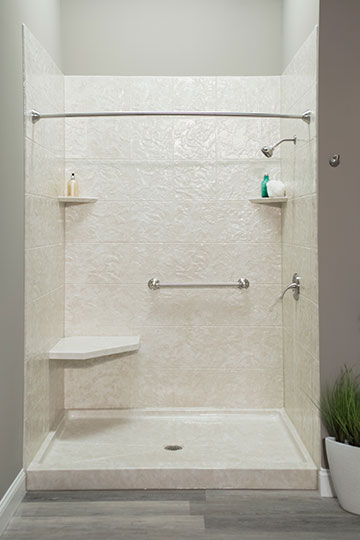
Our systems come in a range of colors and styles, from a flat slab look to a number of tile patterns for people who want the look of tile without living with grout. Storage gets built into the design, whether that is color-matched corner shelves set at a height that works for you or a larger niche recessed into the wall.
If your shower has a window, we cut around it and finish it with a color-matched trim kit that wraps all four sides. It is a small detail, and it is one you would notice right away if it were done badly.
Where the Shower Fits in a Bigger Project
A lot of the time the shower is the whole job. Our tub and shower remodeling work is built for that, handling the wet area without turning the whole bathroom into a job site.
Other times the shower is where a bigger conversation starts. If the tub has been sitting unused, a tub-to-shower conversion or a low-threshold walk-in shower puts that space back to work, and the acrylic system goes in the same way.
And when the whole room needs rethinking, a full bathroom remodel brings in vanities, countertops, flooring, and lighting alongside the shower. The part where we open the wall stays the same no matter the size of the project.
Come Look at It in Person
Color and finish read differently on a screen than they do in your hand. Most people change their minds at least once after seeing the samples.
You are welcome at our Newport Beach or San Diego showroom, or we can bring samples to your house if that is easier. Our gallery is worth a look too, since it shows these systems in real bathrooms.
Start With What Is Behind the Wall
Any shower remodel worth doing starts with knowing what you are working with. Everything else follows from that.
We have been doing this for over 35 years across Orange County, San Diego, and Los Angeles. If you want to know what shape your shower is really in, schedule a free design consultation and we will take a look with you before you commit to anything.